If You Can Swallow the West River
I’ve known about the Saikō-sui koan for a while now.
It’s engraved on Ōmori Sōkun’s tombstone — along with a note saying it was upon hearing it that the master found his vocation. Whether that’s true or a later embellishment, a kind of gift left by someone who loved him, we’ll never know. But the inscription is there, and it stayed in my mind, and eventually I had to look into it.
The koan goes like this. A man approaches a Zen master and asks him the most serious question he can think of: who is the one who is not entangled in the ten thousand things? Who moves through the world without being caught by it?
The master’s reply: when you can swallow all the water of the West River in one single gulp, I will tell you.
That’s it. No explanation. No teaching. An impossible task, handed over like a stone.
The man asking the question was Layman Pang — Pang Yun, 龐居士 — a wealthy merchant and dedicated lay Buddhist practitioner in Tang-dynasty China. The master was Mazu Daoyi, one of the great Chan teachers of the eighth century. The exchange is recorded in the Records of Mazu, and Pang is remembered as having attained sudden insight on the spot, all his doubts resolved.
What I find remarkable is what he said afterward.
How miraculous, how wondrous — I carry wood, I draw water.
Nothing around him had changed. He still had errands. He still had a body and a household and work to do. But something in his relationship to all of it had shifted so completely that the ordinary tasks felt like miracles. Not because they had become extraordinary — but because he was finally, fully, there for them.
He went on to cast his fortune into a river and spend the rest of his life making wooden utensils, trading in pithy dialogue with monks and wanderers, teaching through the texture of his daily existence rather than through any formal instruction.
Sōkun was born into a world where this kind of story was circulating — through Zen monasteries, through the tea ceremony, through the cultural air of late-sixteenth-century Japan. Whether Sōkun encountered the koan through a teacher, a traveler, or a chance conversation — we have no way of knowing. But we know it landed.
At twelve years old, in 1582, he left the samurai path. Not at the beginning of the peaceful Edo era, when that choice would have been relatively legible — but right in the middle of the Sengoku period, when samurai were still very much in demand. He became a lay monk, a kōji, and devoted the rest of his life to Zen and to the hitoyogiri.
I’ve been thinking about why that koan, specifically.
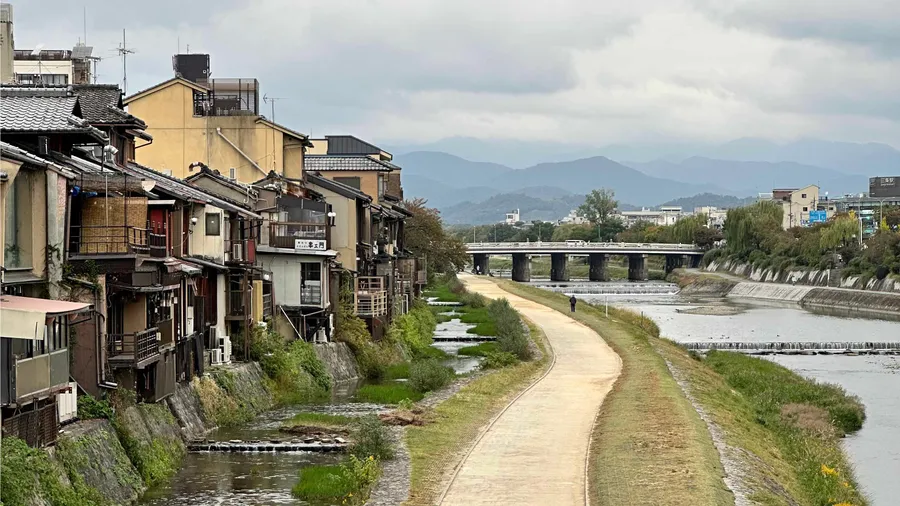
The impossibility is the point — I understand that intellectually. You can’t swallow a river. You can’t grasp awakening through reasoning. The moment you truly feel the wall rather than just think about it, something gives way. But what strikes me now is the shape of the image. A river. Water. Something that flows continuously, that has no edges you can hold, that passes through your hands the moment you try to gather it.
And the instruction isn’t to dam it, or divert it, or bottle it up. It’s to take it all in at once.
That, to me, sounds like what presence actually requires. Not managing the moment, or preparing for the next one. Not lingering carefully at a safe distance from experience. All of it, now, in one breath.
Which is — and I realize this sounds like a stretch, but I don’t think it is — what the hitoyogiri asks of you. Each note is a finite thing. It has a beginning and an ending. It gathers, and tips and dissolves. Your job isn’t to control that arc. Your job is to be there for the whole of it, without the usual urge to lean toward what comes next.
Sōkun understood this. He treated the flute not as a replacement of his Zen practice, but as its expression. One breath, one note. The ordinary made sacred — not by becoming something else, but by being fully, completely itself.
The manuscripts he left behind, the melodies he recorded from the oral tradition, the Sōsa-ryū style he passed to his son and disciples — none of it feels monumental to me. It feels like Pang’s wooden utensils. Humble, persistent, made with the hands. A life that said: this is enough. This is, in fact, everything.
I still haven’t swallowed the West River.
But some days, when a note opens up and I stay in it longer than I think I can, I catch something at the edge of what that might mean.