The Quiet of a Thatched Roof
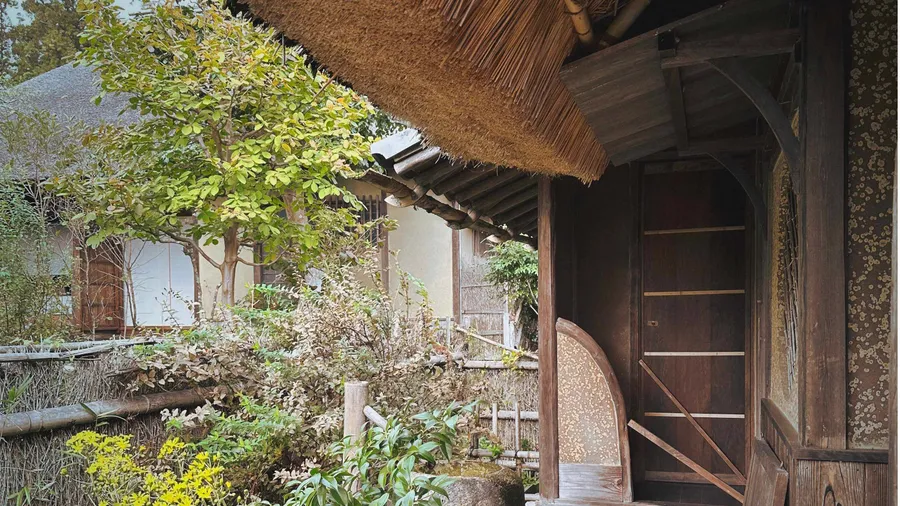
This morning I was working through my ichikotsu lesson. Ichikotsu is the inter-season mode; it has its own repertoire of pieces, and among them is one called Ryo. This melody unfolds around a special hitoyogiri technique called yuri — the repetition of a single note, wave after wave, gently undulating.
Remarkably, echoes from the past reached us, to tell us exactly how to play yuri! In Sokun’s old manuscripts, we can read that the yuri in ichikotsu, and particularly in Ryo, should begin like the quiet of a thatched roof.
I absolutely love this description. But to be honest… I have no idea what rain sounds like on a thatched roof. I can only imagine it as something soft, gentle, perhaps slightly muffled.
So I sat with that image for some time — and a few days ago, while browsing through a newly acquired book — oh, the serendipity of it! — I stumbled upon a reference to it.
The book is called Great Fool: Writings of the Zen Master Ryokan. In one of his poems, Ryokan performed the small miracle of pulling me directly into the scene — into the sensory atmosphere, into the rain, beneath the thatched roof.
After begging all day, I come back home and close the brushwood gate. In my hearth, I build a fire of branches still covered with leaves and quietly recite the poems of Han Shan. A wind from the west brings an evening squall, driving the rain, which softly brushes the thatched roof. At times like this, I lie down and stretch out my legs. What is there to worry about? What is there to trouble me?
Ryokan was a beggar monk from the 19th century. He wrote this poem two centuries after Sokun set down the instructions for Ryo — yet the image had lost none of its weight in the Japanese imagination.
It endured across centuries — and even continents. There is something intoxicating about that kind of transmission: the way a sensation, a quality of sound, can be passed down like a fine aged liquor — transferred from hand to hand, lip to lip, note to note, growing richer with every century it survives. I feel privileged to receive it here, in 2026, through the notes of my little hitoyogiri.
And yet I cannot emphasise enough how much these small things are what hitoyogiri is all about, for me. It’s not just about picking up the flute and making music. It’s about inhabiting a certain aesthetic, a certain state of mind.
Without learning its language, how could a simple bamboo tube ever reveal the secrets coiled around its single node?